Case Study · Thoughtworks
A nationwide platform for opportunity-to-delivery collaboration
Led the design of an enterprise platform that connected teams and workflows across the full lifecycle of complex telecom opportunities and delivery.

Client
Major Telecom Operator, 30 Regional Branches
My Role
Senior Product Designer (sole designer during delivery)
Team
12-person Agile Squad
Timeline
10 months, 2023–2024
Platforms
Web and Mobile
Overview
This project was a national initiative to create a shared collaboration platform across more than 30 regional branches of a major telecom operator.
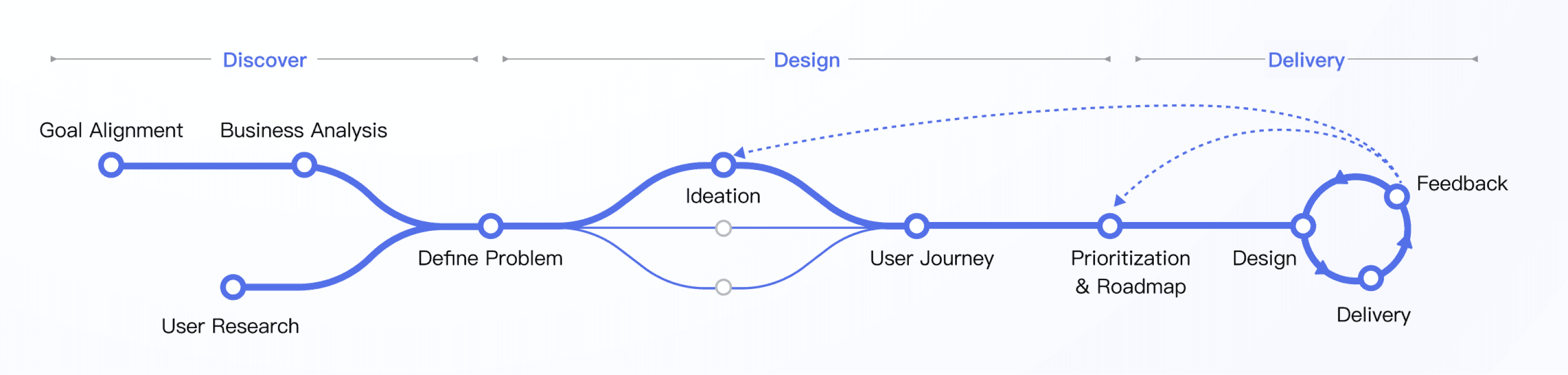
I led the UX across web and mobile, from early discovery through pilot rollout, shaping how different teams could collaborate across the opportunity-to-delivery lifecycle.
Key Issues
Organisational silos, disconnected systems, and offline workflows made collaboration across the opportunity-to-delivery lifecycle inefficient and difficult to scale.
Approach
Outcomes
70 %
Nationwide rollout
Follow-ups
Visibility
Challenges
Because the domain was entirely unfamiliar to me, the project was large in scope, and the timeline was tight, the early discovery and strategy phase came with a number of challenges.
Complex domain with uneven context
Regional variation across branches
Many handoffs, limited time
Problem Framing
Looking beyond the stated pain points
The client had already identified several pain points, but they felt more like symptoms than root causes. To uncover the real issue, I looked beyond individual complaints and focused on how collaboration actually broke down across the lifecycle.
Research under tight constraints
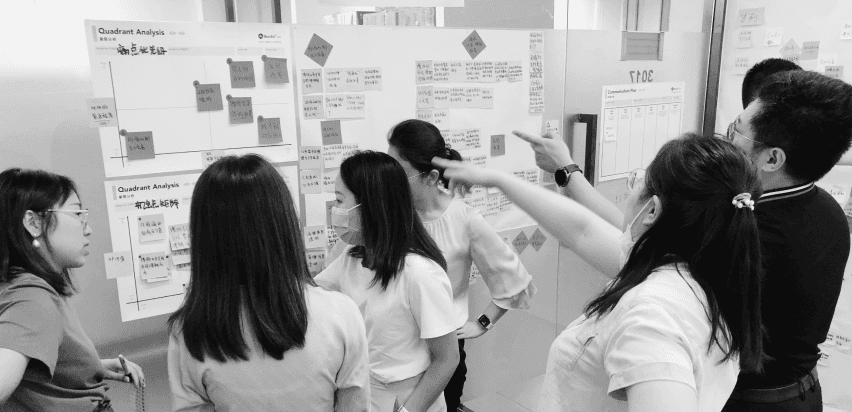
The challenge was learning efficiently in a large, unfamiliar domain with many user roles and a limited discovery window.
I focused on two things:
Mapped an initial as-is journey to surface collaboration breakdowns and guide interviews
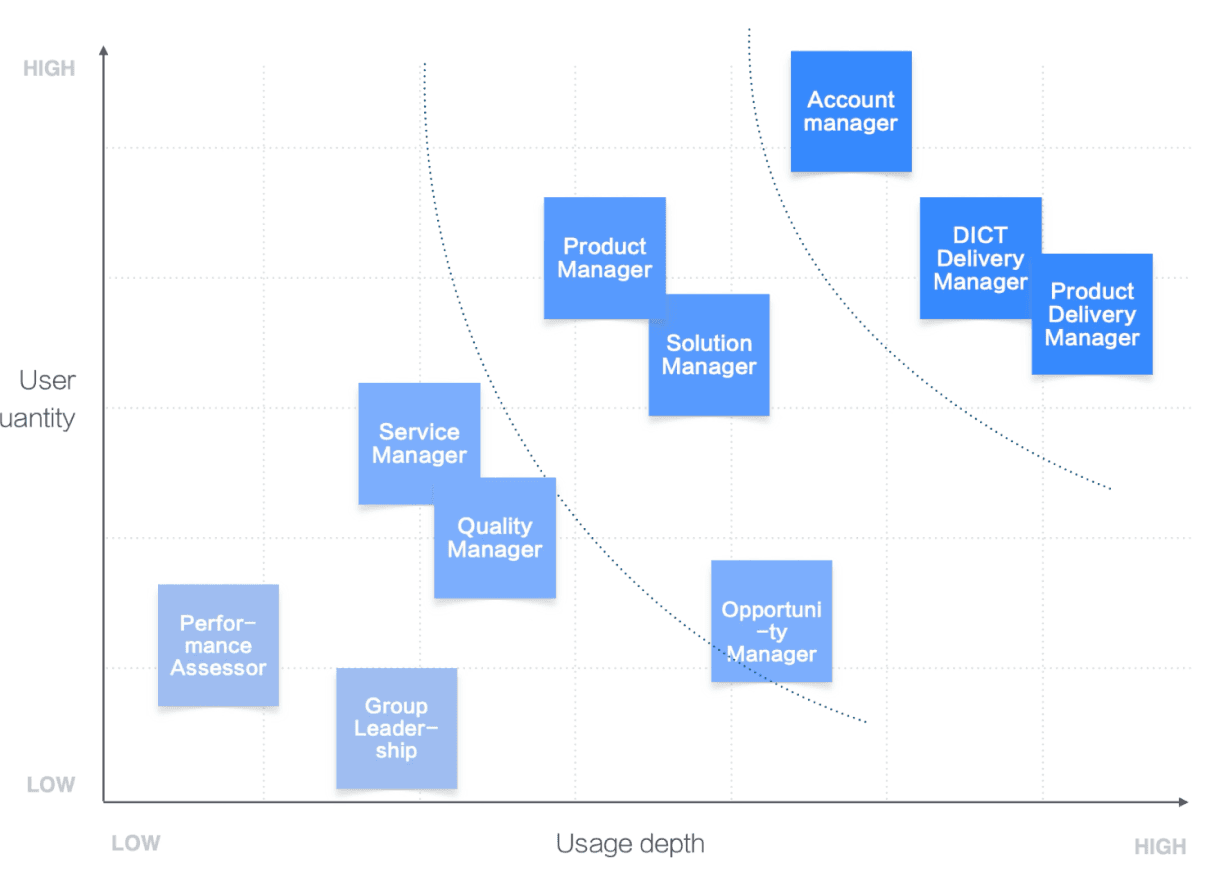
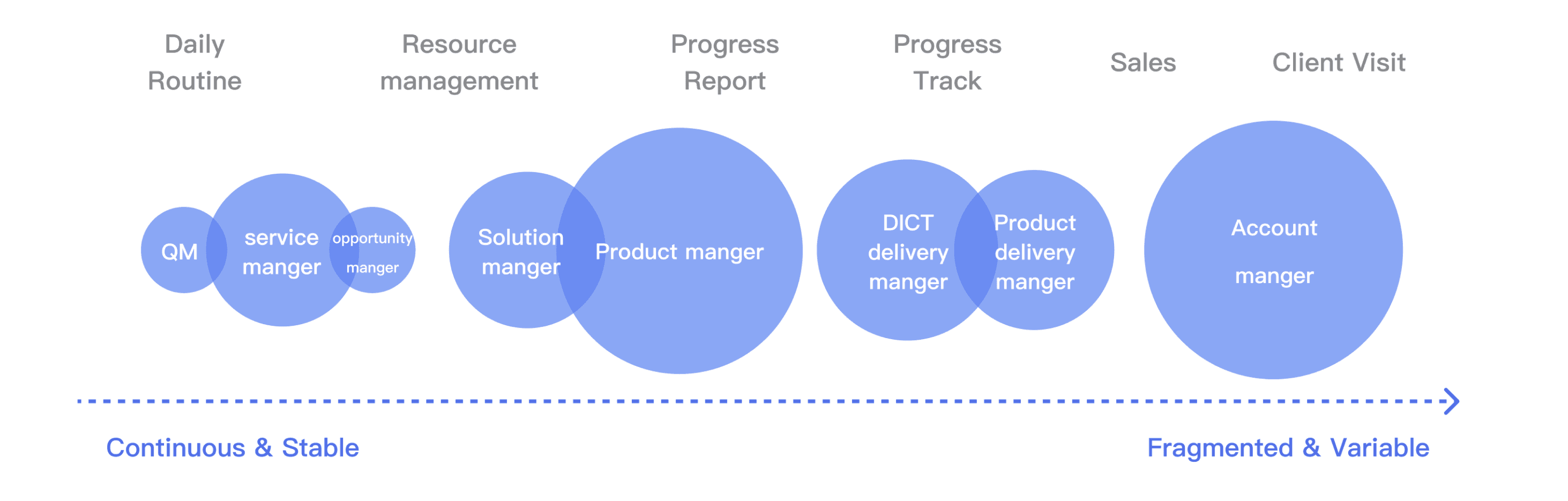
Grouped users by how they contributed to collaboration, so the design stayed focused on real coordination roles rather than job titles alone


Reframing the design challenge
As I mapped the journey and workflow, it became clear that the core issue was not just fragmented tools. The bigger problem was that the right people were not brought in timely, so collaboration often depended on personal relationships instead of a shared system.
“
How might we enable the right people to collaborate at the right time from opportunity initiation onwards, so the lifecycle could scale beyond personal relationships?
”
Where design could have the most impact
Visibility at opportunity initiation became the strongest leverage point. If account managers could bring the right people in earlier, the rest of the collaboration flow had a much better chance of working.
This led to a working hypothesis:
Better supporting account managers at opportunity initiation would improve setup quality and create a ripple effect across the lifecycle.

Solutions
01. Making support work visible
The problem
In pre-sales, once support was requested, visibility dropped, leading to repeated follow-ups and reliance on personal contacts.
Design decisions
I modelled support requests as trackable workflow items, making ownership, status, progress, and deliverables visible in one place.

02. A mobile strategy grounded in real work contexts
Insight from research
Research showed that many critical actions happened outside the office, including visiting opportunities, requesting support, and approving work on the move.
Design decisions
Rather than replicate the full desktop experience, I scoped mobile around the few tasks people genuinely needed to complete on the go, not just replicating the desktop experience.
Lightweight opportunity input
Support requests
Approvals
Quick progress updates during on-site or outdoor work
03. Standardising the opportunity lifecycle
The problem
Across provinces, the overall opportunity-to-delivery lifecycle was similar, but local practices varied enough that handoffs often broke down and progress became hard to trust.
Design decisions
I abstracted regional workflows into a standard opportunity-to-delivery lifecycle. This provided a core stage structure to support nationwide rollout, while still leaving room for to handle local practices.


04. Used usability testing to sharpen the workflow
What testing revealed
I conducted usability testing before the pilot and surfaced three issues: unclear guidance in complex flows, hesitation in forms, and difficulty scanning mobile opportunity cards.
What I updated
I used those findings to refine the experience in three areas:
Added in-context guidance at critical moments
Improved form usability with clearer language, step feedback, and error prevention
Simplified mobile opportunity cards by prioritising status, ownership, and key signals


Follow-up testing showed a 30%+ improvement in task completion, with noticeably fewer drop-offs at key steps.
Reflections
Real impact comes from a few critical point
In this nationwide project, I was tempted at first to chase every edge case. But the bigger shift was learning to focus on the few moments that shaped collaboration the most. That made the tradeoff between consistency and local reality much clearer to me.
Validate early in ambiguous contexts
In a 0–1 project, many decisions begin as assumptions. In ambiguous situations, early validation matters more than polished thinking. Bringing users into the process earlier helped us test the direction before the system became too detailed to change easily.
The more I worked with users, the more my understanding of them kept evolving throughout the project, even during later delivery phases. Continuous testing and feedback not only improved the design, but also gave the team more confidence that we were building the right thing.